
In a healthy body, the dopamine system functions as a precise feedback mechanism. When a need arises—for example, when you’re hungry—dopamine levels drop slightly, creating a sense of discomfort. This drop serves as a signal to take action. You switch to “hunter” mode, obtain food, eat—and dopamine rises, returning to its original level. The drop indicates a need; the rise indicates a reward. This is exactly how healthy learning occurs: you performed an action, received a result, and the brain memorized the correct sequence.
But this system can be disrupted. The most obvious way is to use direct stimulants to “jump over your head.” A person with a low baseline tone wants to feel better. They’re offered a free sample—and they agree. The danger of a freebie is that it powerfully stimulates dopamine, and learning occurs at the midbrain level, bypassing consciousness. You may fully understand that this is a marketing ploy, but your midbrain will still remember: this product is associated with pleasant sensations. And you’ll buy it again and again, even if your mind objects.
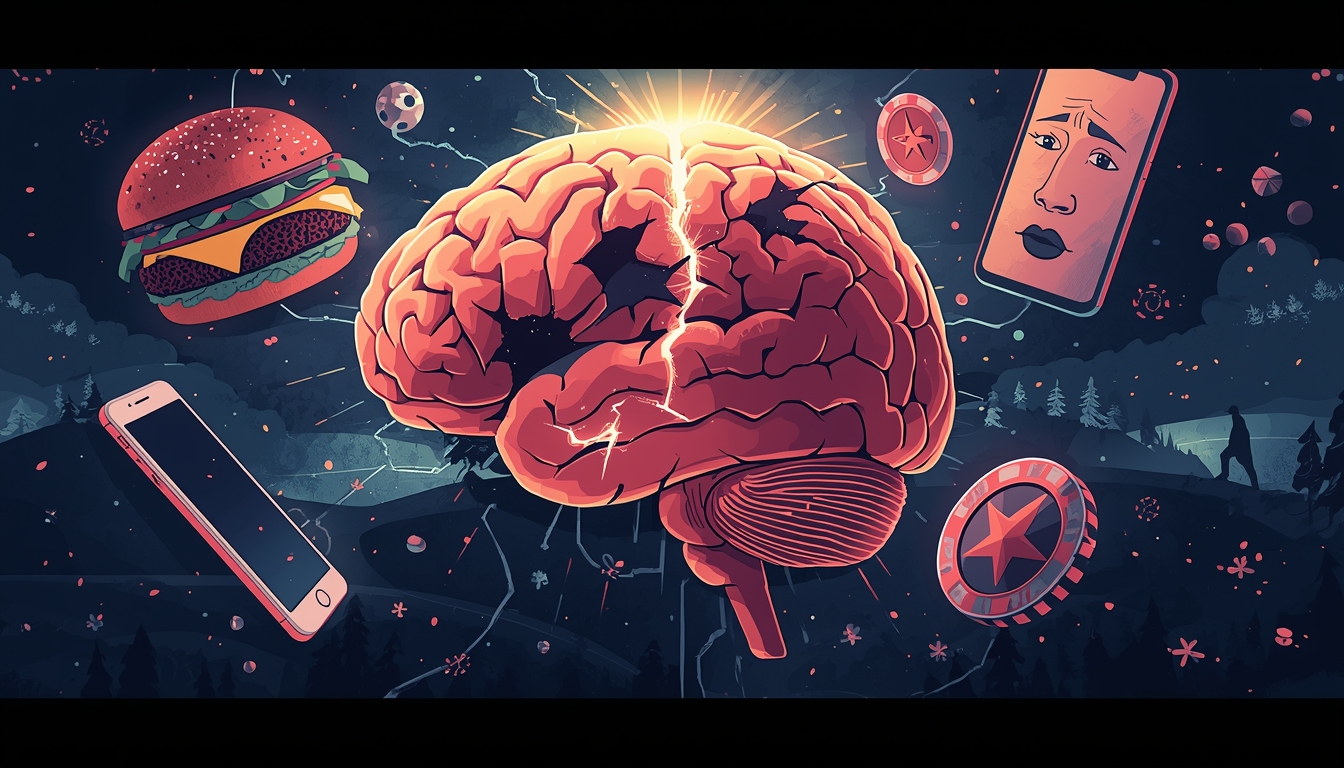
Another destructive mechanism is the combination of stimuli. Pizza, cola, TV, music, a cigarette, coffee—each of these stimuli individually triggers a small dopamine release. But together, they add up and can rewire the brain just as effectively as hard drugs. A general safety rule: no more than one strong stimulant at a time. Eating in front of the TV is already risky, but it’s still safer than eating while watching TV, scrolling through your phone, and sipping alcohol at the same time.
Superstimuli pose a particular danger. These are objects in which certain features are exaggerated to such an extent that they stimulate the brain more strongly than any natural stimuli. A classic example is the waist-to-hip ratio. The healthy, evolutionarily determined ratio is 0.7. But the brain reacts more strongly to 0.5—a wasp waist achieved through corsets or surgery. This does not exist in nature, and the brain is not prepared for such deception. Porn, Photoshop, endless feeds of “perfect” lives—all of these are superstimuli that hypnotize us and trigger an inappropriately strong dopamine response.
Stress plays a dual role. During acute stress, dopamine levels rise—which is why some people subconsciously seek out stressful situations; they seek stimulation from them. But with chronic stress, a distortion occurs: in the areas responsible for self-control, dopamine decreases, while in the areas responsible for cravings and emotions, it increases. This means that under chronic stress, the appeal of temptations increases, while the ability to resist them decreases. A vicious cycle forms: stress lowers dopamine, and low dopamine makes you more sensitive to stress.
So what can be done? There are two approaches. The first is an ascetic environment, reducing overall stimulation. This increases receptor sensitivity and self-control. But this doesn’t work for everyone. People with different genetics react differently to stress and reinforcement. Some need an enriched environment—maximum variety of stimuli, choices, and tools for interacting with the world. The more skills and resources a person has, the easier it is for them to build a healthy dopamine system. The second approach is managing attention. Attention is a finite resource. Wherever you direct it, that is where significance grows. If you don’t control your focus, it gets hijacked by overstimuli, and there simply isn’t enough dopamine fuel left for personal growth. Conscious attention allocation is perhaps the most accessible and effective tool for making dopamine work for you, not against you.



Leave a Reply