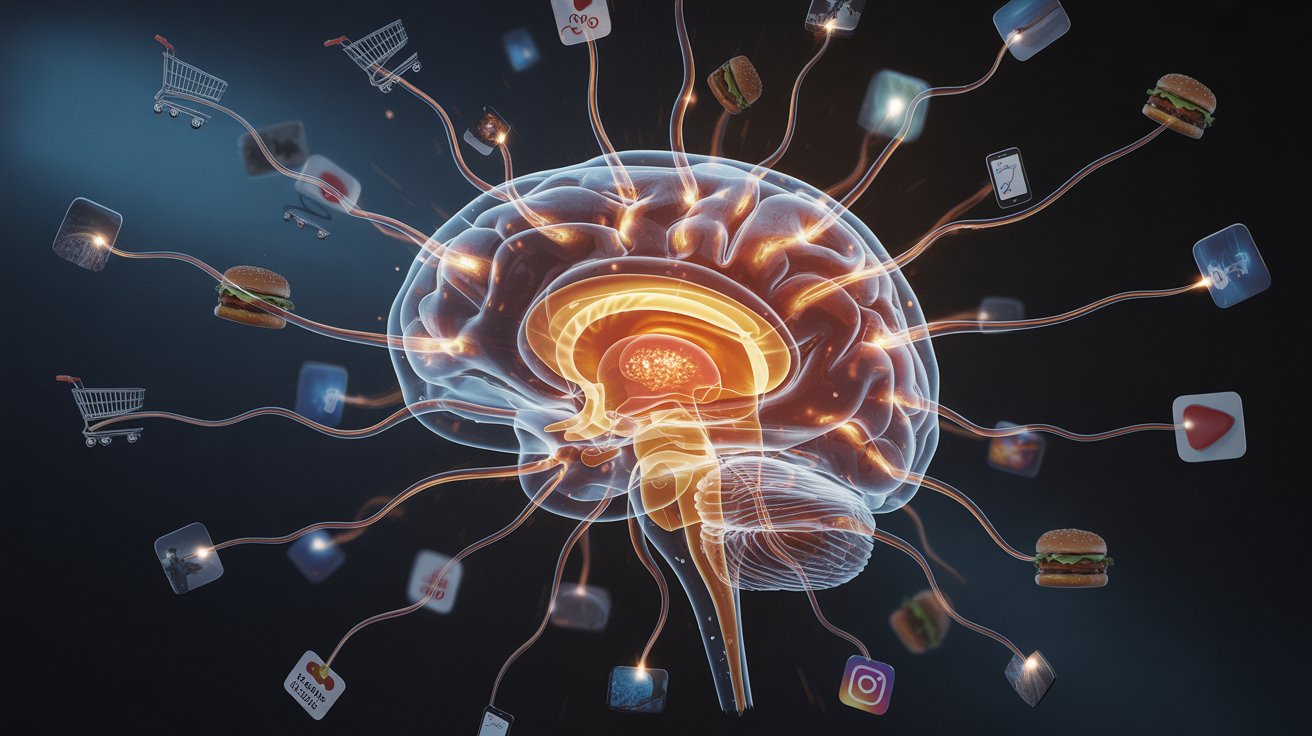

The dopamine system occupies a unique place among the body’s neurotransmitter systems. It is the only system capable of learning without conscious involvement. When we become addicted, when something begins to seem important to us or, conversely, causes aversion—all these processes occur at the level of the midbrain, bypassing the cerebral hemispheres. Even if we were to theoretically “shut down” the cerebral cortex, we could still be taught to love or dislike something.
It is precisely this unconscious learning that shapes our system of priorities. What we spend our time on, what we consider important or unimportant, in most cases takes shape without our conscious involvement. And here lies a fundamental point: if we do not control this process ourselves, someone else controls it—the environment, advertising, social triggers, marketing strategies. The dopamine system is constantly reorganizing itself, changing its sensitivity. The more we stimulate it by any means—from codependent relationships to endless content consumption—the further the desired sensation slips away. This is the classic raising of the reward threshold: gradually, we need more and more.
Why does this happen? The dopamine system is designed in such a way that it prevents us from achieving absolute satisfaction in life. The higher the level of stimulation, the fewer sensitive receptors remain on the cells—this is a self-regulatory mechanism. There are only about seven thousand dopamine neurons in the brain, whereas the total number of brain cells reaches 84 billion. They are lost easily and quickly: addictions, severe stress, and exposure to toxins can irreversibly reduce their number. This leads to a condition known as reward deficiency syndrome: the stimulus remains the same, but no longer brings joy. In the worst cases, it even begins to cause aversion.
Modern diseases of civilization are directly linked to an excess of dopamine stimulation. Whereas people used to suffer from food shortages or severe infections, today most problems are caused by excess. Our brains are not prepared for the volume of visual, gustatory, and social stimulation that bombards us daily. Advertising, social media, the availability of food, sexualized imagery—all of this triggers trigger “bombards” the dopamine system, and this constant jolt imperceptibly depletes our resources.
Meanwhile, the influence industry isn’t standing still. Huge research labs are studying how to strike a chord in consumers’ hearts with greater precision. Neuromarketing, personalized advertising, and content-selection algorithms are becoming increasingly sophisticated and hitting the most sensitive spots with ever-greater accuracy. Dopamine is both the weakest and the strongest link in our psyche, and understanding its mechanisms provides the key to ceasing to be an object of manipulation and beginning to consciously manage our own motivation.


Leave a Reply